
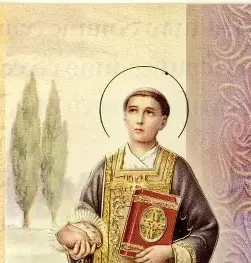
“When they heard these things, they became enraged and ground their teeth at Stephen. But filled with the Holy Spirit, he gazed into heaven and saw the glory of God and Jesus standing at the right hand of God. ‘Look,’ he said, ‘I see the heavens opened and the Son of Man standing at the right hand of God!’ But they covered their ears, and with a loud shout all rushed together against him. Then they dragged him out of the city and began to stone him; and the witnesses laid their coats at the feet of a young man named Saul. While they were stoning Stephen, he prayed, ‘Lord Jesus, receive my spirit.’ Then he knelt down and cried out in a loud voice, ‘Lord, do not hold this sin against them.’ When he had said this, he died. And Saul approved of their killing him.” (Acts: 7:54-60; 8:1)
CATHOLIC FEAST DAY: December 26
PATRON SAINT: Deacons, Altar Servers, Bricklayers, Casket Makers, and Stonemasons
YEAR OF MARTYRDOM: c. AD 34-35

In the Acts of the Apostles, scripture tells us that Saint Stephen, along with six other men, Philip, Prochorus, Nicanor, Timon, Parmenas, and Nicolaus were ordained as the first Deacons of the Church by the apostles to assist in the corporal works of mercy to the poor (specifically the widows of Hellenists) so that the apostles would have more time to spread the word of God in the early decades of the Church of Christ. As is stated in the Acts of the Apostles, (Acts: 6:5) Stephen was “a man full of Faith and the Holy Spirit,” and while he fulfilled his primary mission to care for the poor and needy, his work did not end there. He was very well versed in theological matters and took the message of Christ to the Hellenistic synagogues around Jerusalem where he debated Jewish leaders, leading to a sentiment of growing ire against him from the Jewish leaders that would inexorably result in his martyrdom.
Saint Stephen’s life prior to his conversion is not known but scholars believe that he was a Hellenist (a Greek speaking Jew influenced by Greek culture and ideas) and a Samaritan (known for their unorthodox theological beliefs including the rejection of the centrality of the temple worship in Jerusalem). As Michael Bauman writes, “That Stephen was a Hellenist is deduced from the fact that his parents gave him a Greek name (Stephanos – the other deacons also had Greek names) and that the segment of Christian people he was elected to serve were Hellenists themselves.” His Samaritan roots are deduced from his speech in defense of the early Christian Church and its message before the Sanhedrin during his trial, the longest recorded speech in the Acts of the Apostles, which references the Samaritan Pentateuch, which would only be referenced by a Samaritan. As Miachael Bauman writes:
Stephen’s recorded defense not only contains a Samaritan-like attack on the Temple and a presentation of Jesus as Messiah; it also contains allusions to numbers and events found only in the Samaritan Pentateuch. This remarkable fact underscores not only his Samaritanism but also the historical reliability of Saint Luke’s account, which in all other places employs a different version of the Old Testament Scriptures. (Bauman, 2024)
It is unclear when Stephen received the gift of Faith and conversion though tradition holds that he was one of the 70 disciples chosen by Jesus to go out and preach in the New Testament. As a Hellenist, Stephen had a much broader appreciation of the wider non-Jewish world and his more liberal education likely made him a formidable orator and debater. Acts of the Apostles recounts that he did great deeds and had multiple theological disputes with the Jews in Jerusalem, leading to his angering the Jewish leadership. Because of his success in evangelization, and their inability to convincingly debate his theological message, the Sanhedrin (the Jewish leaders), believing that his message was heretical, resorted to distorting Stephen’s teachings and eventually denouncing him as a heretic. As they did with Jesus before him, the Sanhedrin called “false witnesses” to testify against him accusing him of advocating the destruction of the Jewish temple in Jerusalem and an overthrow of Jewish law. Of note, one of the individuals involved in these proceedings against Stephen was Saul, who would later become Saint Paul.
Following the accusations, Stephen defended himself, and the early Church, in a long speech – as noted previously, the longest speech recorded in the Acts of the Apostles – recounting the historical precursors of the early Church by invoking the Old Testament, specifically the Samaritan Pentateuch, and chastising the Jews for their spiritual intransigence through the ages which only served to enrage the Sanhedrin even more. Before he could finish his defense, the Sanhedrin descended on him in rage. As they approached him, Saint Stephen described a mystical vision of the Heavens opening up and seeing our Lord, Jesus Christ standing at the right hand of the Father, which the Sanhedrin saw as blasphemous and served only to embolden them to bypass usual procedures and take him out to the place now known as “Stephen’s Gate” where they proceeded to stone him to death.
Amazingly enough, as he was being stoned to death, as recounted in the Acts of the Apostles, Saint Stephen, like Our Lord Jesus Christ on the cross, commended his soul to God, the Father. He then dropped to his knees, an act witnessed by Saul (later Saint Paul), and started to pray for his assailants. As Jesus before him, and as many martyr saints after him, Saint Stephen begged our Lord to not hold this “sin against them.” He asked our Lord to forgive his assailants, his last act prior to his death.

As a witness to this last act of heroism and mercy, many believe that Saul’s conversion would not have been possible without this witness. While Saul continued to persecute the Christian community after witnessing, and partaking in, this tragedy, it is clear that his heart and soul would not have been prepared for the vision he experienced on the road to Tarsus that ultimately resulted in his conversion, had it not been for Stephen’s witness to Faith. Bauman writes, “As Saint Augustine later wrote, ‘If Stephen had not prayed, the Church would not have had Paul.” (Bauman, 2024)
References:
- Bauman, Michael. Saint Stephen (2024). EBSCO. Accessed online on 7/2/2026 at: https//:www.ebsco.com/research-starters/biography/saint-stephen.